TAKE ACTION FOR MUDDY CREEK HERD - UT
TAKE ACTION:
One Wild Horse Every 6 Square Miles?
Deadline for Public Comments: August 5, 2026
TAKE ACTION: One Wild Horse Every 6 Square Miles?
Deadline for Public Comments: August 5, 2026
Imagine traveling across 442 square miles of Utah's spectacular high desert hoping to catch a glimpse of a wild horse—only to learn there is, on average, just one horse every 6 square miles.
That is the future the Bureau of Land Management (BLM) is proposing for the Muddy Creek Herd Management Area (HMA).
The Muddy Creek HMA encompasses approximately 283,400 acres—442 square miles—including roughly 271,000 acres of BLM-managed public land.
BLM wants to reduce the herd to just 75 wild horses across this vast landscape—while continuing to authorize substantially more livestock use on the public lands within it.
And reducing the number of horses is only part of the plan.
BLM proposes skewing the herd's sex ratio to 60% male/40% female and using fertility-control methods that include GonaCon and IUDs—all after reducing the population to the lowest end of an AML that hasn't changed since 2008.
BLM can—and should—do better.
Please sign the petition below urging the agency to reject this deeply flawed proposal and adopt a humane, science-based management approach that protects the Muddy Creek herd and its habitat for future generations.
What's Wrong with BLM's Proposal?
Just 75 Wild Horses Across 442 Square Miles
BLM proposes managing the Muddy Creek herd at an Appropriate Management Level (AML) of just 75–125 wild horses across approximately 283,400 acres—442 square miles. Of that total, approximately 271,000 acres are BLM-managed public lands.
At the low end of AML, that works out to roughly one wild horse for every 6 square miles.
BLM itself acknowledges that “cover and space are plentiful” for wild horses in the Muddy Creek HMA. The agency instead identifies forage and water availability as limiting factors, particularly in preferred horse-use areas and during severe drought.
Yet rather than reevaluating whether an AML of just 75–125 horses remains appropriate for this enormous landscape, BLM proposes removing horses until the population reaches the very bottom of that range.
A Herd Management Area should be managed to sustain a healthy, viable wild horse herd—not toward the smallest population BLM's existing management plan will allow.
Hundreds of Cattle—But Wild Horses Bear the Burden
BLM points to deteriorating range conditions as justification for reducing the wild horse population.
Yet livestock grazing continues on public lands throughout the HMA. BLM's Management Evaluation states that 11 cattle grazing allotments partially or entirely overlap the Muddy Creek HMA and that livestock use has averaged approximately 50% of permitted use during the last ten years.
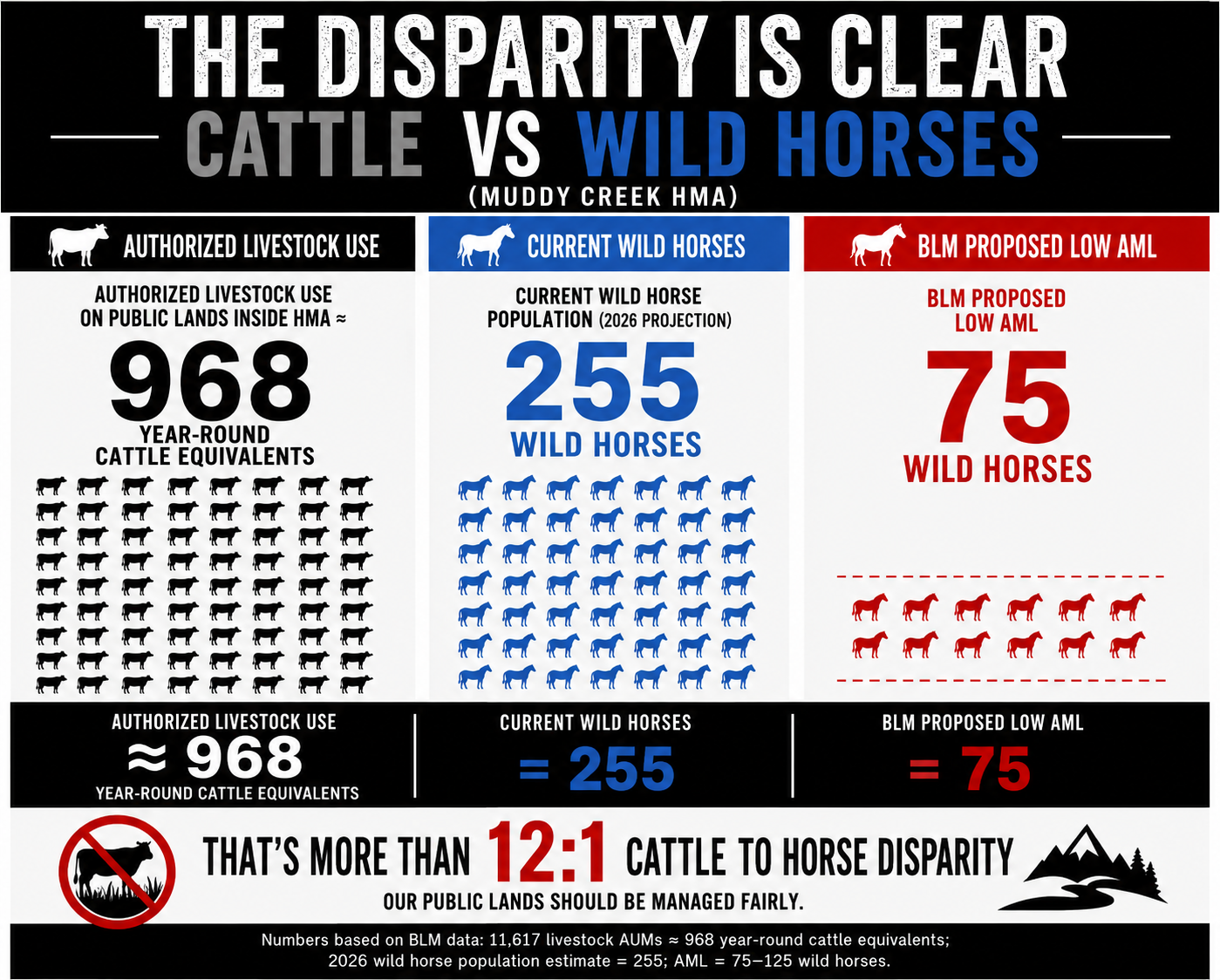
BLM's Environmental Assessment authorizes livestock use equivalent to nearly 1,000 year-round cattle—more than 12 livestock for every wild horse at the proposed low AML.
Even under proposed livestock grazing reductions, the equivalent of approximately 388 year-round cattle would remain, compared with just 75 wild horses at low AML.
If forage is truly insufficient, BLM must meaningfully examine all uses of the range rather than repeatedly placing the burden of achieving balance on wild horses.
BLM Identifies Another Solution: Improve Water
BLM identifies water availability as a limiting factor for wild horses in Muddy Creek. But the agency also acknowledges that some reservoirs and tanks have filled with sediment, reducing their water-holding capacity and causing them to go dry during critical periods.
Earlier in the evaluation, BLM notes that most developed water sources are only in fair condition, with many needing repair or general maintenance.
Most importantly, BLM acknowledges that maintaining multiple reliable water sources can improve wild horse distribution, “leading to improved health of the herd and the rangelands they depend on.”
If better distribution can reduce concentrated impacts around limited water sources, BLM should prioritize maintaining and improving those resources—not simply reduce the herd to 75 horses.
BLM Wants Just 75 Horses—Then Plans to Suppress Reproduction
BLM proposes gathering and removing wild horses until the herd reaches the low AML of just 75 animals.
The horses returned to the range would then be managed toward a 60% male/40% female sex ratio, and mares could receive fertility-control treatments including PZP vaccines, GonaCon, IUDs, or newly developed vaccine formulations.
In other words, BLM isn't simply proposing to reduce the herd to 75 horses. It wants to reduce the herd to 75, reduce the proportion of breeding females, and suppress reproduction among the mares that remain.
Of particular concern is BLM's proposed use of GonaCon. Unlike reversible PZP fertility control, repeated GonaCon treatments raise serious concerns about long-term or permanent infertility. Peer-reviewed research has found that as few as two applications can result in permanent sterilization in some treated mares.
For a herd already being reduced to such a small population, permanently removing mares from the breeding population could have lasting consequences.
Genetic Diversity Has Already Been a Concern
During scoping, numerous commenters warned that the Muddy Creek herd is already experiencing inbreeding and that an Appropriate Management Level below 150–200 horses is not genetically sustainable.
These concerns are particularly significant given the herd's documented genetic history. Genetic testing of Muddy Creek horses collected in 2001 found very low observed heterozygosity, or individual genetic variability, below the proposed critical value used at the time. BLM subsequently introduced horses from other HMAs in an effort to improve genetic variability.
Importing outside horses, however, is not a substitute for maintaining a sufficiently large, genetically viable resident population. Repeated introductions also risk altering the distinguishing characteristics of the Muddy Creek herd—characteristics that BLM's own management objectives call for maintaining, enhancing, and perpetuating. Those objectives specifically contemplate introductions only when the horses have characteristics similar to those of the receiving herd.
Despite these concerns, BLM proposes reducing the herd to just 75 wild horses while also suppressing reproduction among the mares that remain, without adequately demonstrating how these combined measures will protect the herd's long-term genetic health and viability.
What Happened to Their Habitat?
The Muddy Creek HMA once encompassed substantially more habitat available for wild horse use.
Over time, BLM has eliminated approximately 25–30% of the herd's historic habitat from wild horse use.
That history matters.
BLM should not evaluate today's population, forage, and water conditions without accounting for the habitat wild horses have already lost—or considering whether appropriate habitat can be restored to their use.
Tell BLM: Protect the Muddy Creek Herd
Public comments are due August 5, 2026.
Please add your name to The Cloud Foundation's petition calling on BLM to reconsider this proposal and pursue management that:
Reevaluates whether an AML of just 75–125 wild horses is appropriate for the Muddy Creek HMA;
Maintains a healthy, genetically viable wild horse population on the range;
Meaningfully evaluates livestock grazing alongside wild horse use when addressing forage and range conditions;
Prioritizes repair, maintenance, and improvement of water sources to improve wild horse distribution and rangeland health;
Rejects fertility-control strategies that risk permanently sterilizing mares;
Rejects artificial sex-ratio manipulation that further reduces the herd's reproductive population;
Considers restoring historic habitat that has been eliminated from wild horse use; and
Prioritizes humane, science-based, on-range management rather than continued removals and population suppression.
The Muddy Creek HMA was designated for wild horses. They deserve more than one horse for every 6 square miles.
Click below to add your name to our petition and/or submit your personal comments today.
Muddey Creek BLM Background Documents & Project Information Access
BLM Muddy Creek Herd Management Area Plan (HMAP) Environmental Assessment (July 2026)
Click Here If You Have Trouble with This Form or Wish To Submit Comments Directly to BLM
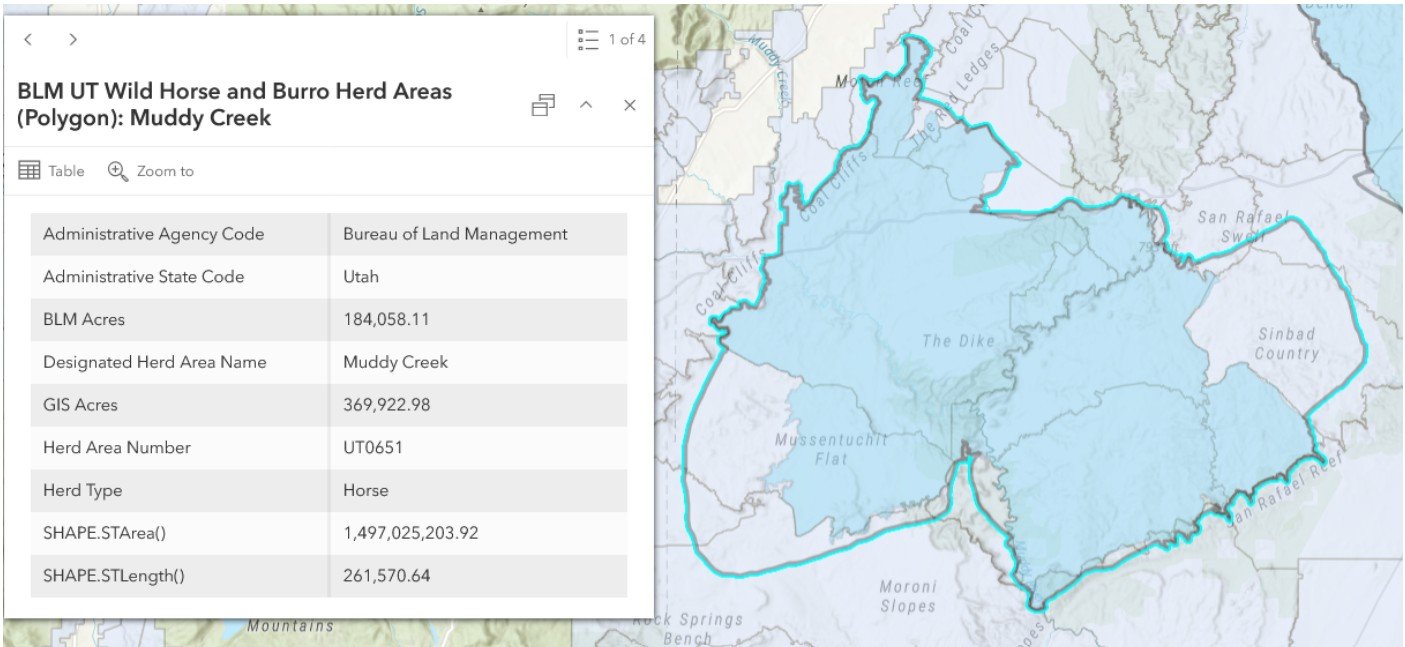
Muddy Creek HMA (blue outline = original HA/herd area; blue shaded area = current HMA). This map shows how large sections have been eliminated from wild horse use. NOTE: All gray lines within (and without) the HA/HMA show livestock allotment boundaries!
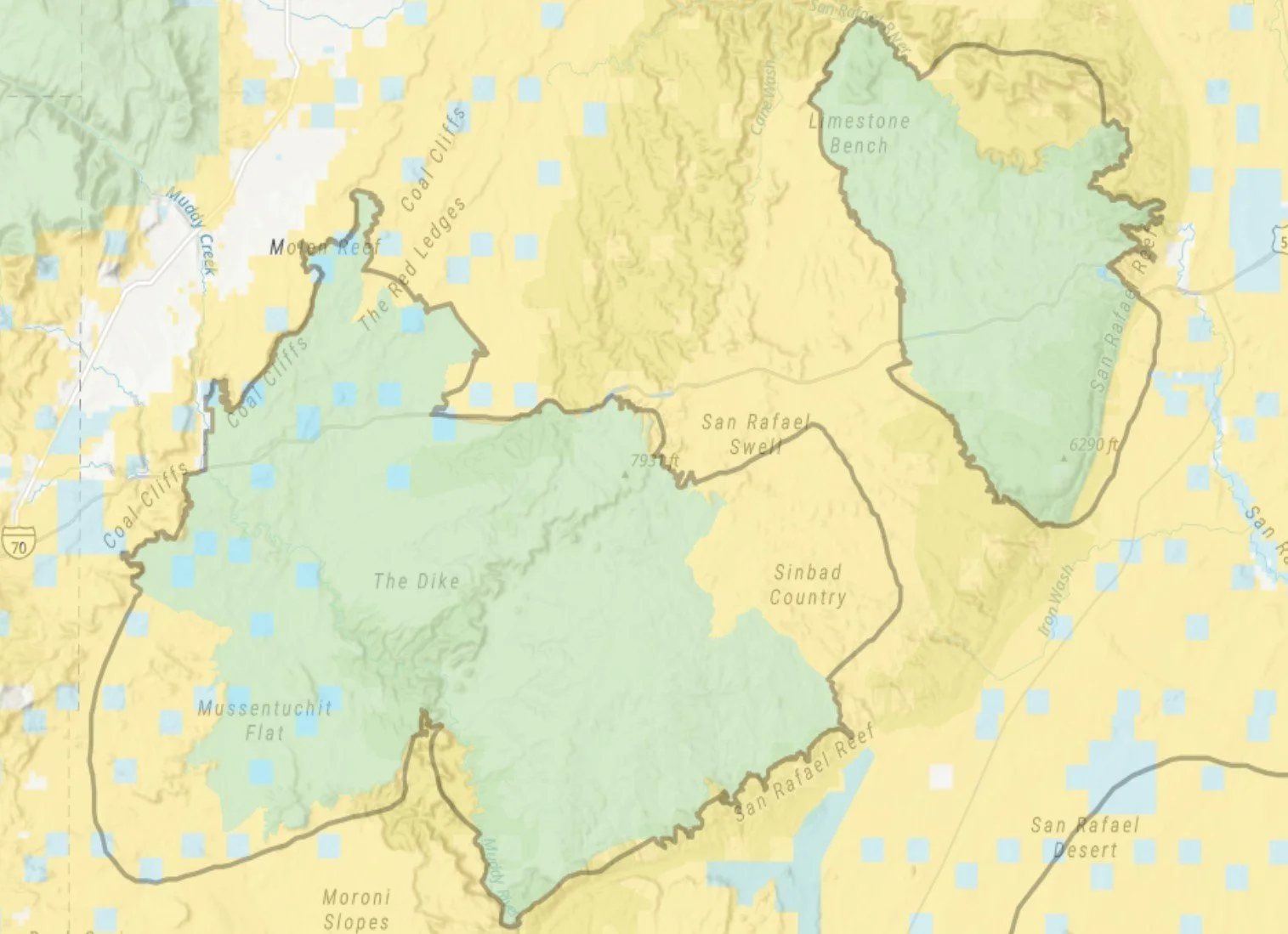
Muddy Creek (L - wild horse) and Sinbad (R - wild burro) herd areas... now separated?
This map shows the Muddy Creek and Sinbad herd areas, which appear to have once formed a more contiguous habitat (blue boxes in Muddy Creek HMA = private land plots). Today, they are divided by a strip of BLM managed lands (shaded yellow) not designated for wild equids—which further restricts movement, habitat connectivity, and long-term herd viability.