May 8 is World "Burro" Day!
In honor of World Burro Day, we’re sharing this thoughtful and in-depth article by longtime advocate Charlotte Roe exploring the history, ecological importance, challenges, and resilience of America’s wild burros.
Often overlooked, wild burros are intelligent, deeply social animals who deserve protection, respect, and a future on our public lands.
Guest Article:
” What's the Story on Wild Burros”
by Charlotte Roe
Of the many species threatened by humans, few are as misunderstood as Equus Asinus. Donkeys, commonly called burros in the American West, Latin America, and Spain, have long served humans as workers and companions. For hundreds of years, wild burros on our public lands have persevered against devilish heat, biting winds, drought, and predation. Their story reaches back to the Egyptian pharaohs. A donkey watched over baby Jesus in the manger; one carried him to Jerusalem. In modern times, unlike horses with their royal imagery, donkeys have been considered as mobility for the poor. Within much of the wild horse advocacy movement, wild burros are an afterthought. Last but not least, to those who know them, they are one of the most intelligent, steadfast, and curious animals.
The Wild Free-Roaming Horses and Burros Act of 1971 makes free burros a federally protected species “in the area where presently found, as an integral part of the natural system of the public land.” Yet federal land management agencies, clueless academics and media use terms like exotic, invasive, destructive and overpopulating to justify shrinking their numbers in lawfully designated habitat. Echoing the ranching and mining interests that dominate our public lands, most environmental organizations treat them as invasive pests. According to the Wildlife Society, burros are “among the most widespread and serious threats to the integrity of native wildlife populations.” Not one study validates this name-calling. But the dogma persists.
A Long Haul
Before the combustible engine, burros were the powerhouses, building railroads, packing goods, plowing fields, hauling gold and silver from underground. In developing countries today, working burros till the soil, transport crops and heavy loads across rough terrain, connecting remote rural communities to markets. They are vital to cultural and economic traditions that stretch back to roughly 7,000 years, when donkeys were first domesticated.
Donkeys share common ancestry with horses and zebras, which evolved from the small, multi-toed Eohippus that emerged in North America during the Eocene epoch some 55 million years ago, eventually giving rise to the species Equus, then split into Equus Asinus several million years ago. One branch, Equus Africanus, inhabited the deserts and mountainous areas of the Horn of Africa and Egypt and gave rise to modern donkeys. Their powerful, curved teeth and digestive system enabled them to survive where coarse vegetation, scarce rainfall and scattered forage called for tough constitutions. These donkeys first arrived in North America with Spanish conquistadors in 1498.
Driven Away For Who They Are
They go gently on the land. As a budding ecologist, Erik Lundgren found clusters of holes dug by burros in the Sonoran Desert. The watering holes attract other wildlife species, including bighorn sheep, javali, elf owls, and mule deer. Eventually, the burro wells, up to two meters deep, become vegetation nurseries. Like other large mammalian herbivores, burros are a keystone species that browse rough shrubs, traveling large distances for low-nutrient forage that could otherwise fuel wildfires.
The Bureau of Land Management, Forest Service, and Park Service have a different angle. BLM’s Appropriate Management Levels (AMLs) are nominally the number of animals that can sustain a “thriving natural ecological balance.” In fact, AMLs are arbitrary quotas that prioritize private owners of livestock, mines and other extractive industries. Leading equine geneticist Gus Cothran has found that a wild herd size of 150-200 adults is the minimum needed to protect genetic health for equids. Of the 38 Herd Management Areas with burros, the vast majority have quotas far below 100.
In 2017 the National Cattlemen’s Association made an agreement with the Humane Society, ASPCA and Return to Freedom called The Path Forward whose aim is “10 Years to AML.” The animal welfare organizations joined the pact allegedly to promote humane range management and prevent sending captured wild equids to slaughter. In fact, the pact contributed to even more inhumane treatment and expansion of the slaughter pipeline. Since 2020, this population suppression language has been embedded in Congressional appropriations report language. In 2025, BLM estimated wild burro population at 19,333, not much over the 14,646 it counted after Congress passed the Wild Horse Act to keep wild equids “from fast disappearing from the West.” BLM’s low AML target would slice these already precarious burro herd numbers to 2,101.
Management by Extermination
Under cover of the Path, BLM revved up its drive to wrest wild burros from their homelands. Between 2020 and 2025, it reported “gathering” 9,320 burros, largely from the Sinbad and Canyonlands HMAs in Utah; the Blue Wing Complex and Marietta Range in Nevada; the Black Mountain and Havasu HMAs in Arizona. In 2026, the BLM plans to round up 2,163 burros from the Lake Pleasant HMA in Arizona (to a low AML of 140); 1794 burros - 85 percent of the population - are targeted for removal from the Three Rivers Complex, also in Arizona. BLM also plans to “zero out” the 104 burros inhabiting the Tassi-Gold Butte HMA in Arizona.
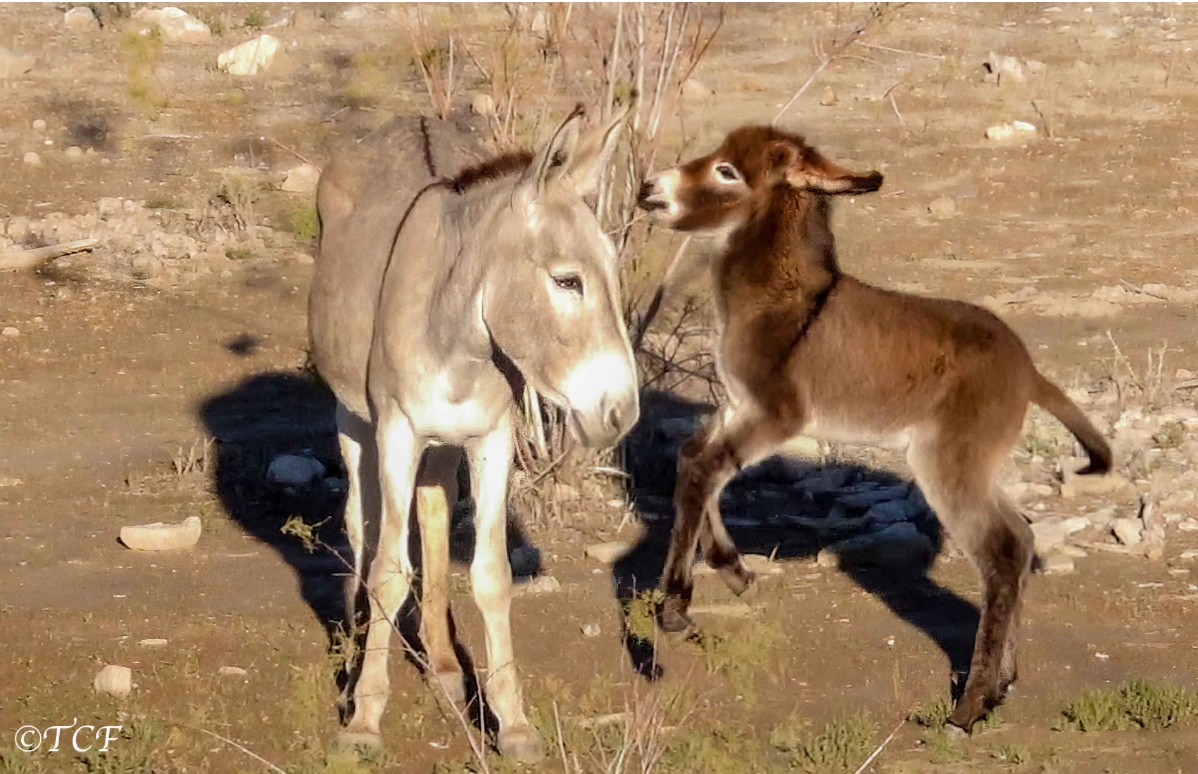
For years the National Park Service has persecuted wild burros inhabiting Death Valley National Park as destructive invaders, even though they’ve inhabited this lonesome desert for hundreds of years. NPS is not covered by the Wild Horse Act and wants no burros on its lands; until the late 1980’s, it gunned down thousands of burros in Death Valley. Marauders still occasionally shoot burros there with apparent immunity. In 2019, 40 burros were shot dead, their killers never found. NPS plans to round up the last remaining burros from the Park, yet it permits cattle grazing in select Death Valley allotments, including areas around the Joshua trees.
Helicopter roundups are traumatic for horses, often leading to abandoned foals, broken legs and necks, and mustangs perishing from exhaustion and despair. The “gathers” are even more deadly for the long ears. Instead of fleeing and stampeding, burros freeze in a fight position or scatter, resulting in long-distance, aggressive, and dangerous chases. Contractors have been filmed resorting to brutal methods such as electric cattle prods, roping, and even flipping burros on their backs to exert control.
The stress of being run down, separated, hauled, and imprisoned exposes burros to diseases their immune systems can’t handle. FOIA documents have revealed that more than 20% of burros die within a year of capture. The capture stress activates dormant pathogens. Hyperlipemia, a major cause of death related to stress disorder, hits burros particularly hard. The Sinbad gather from Utah left three dozen burros dead during and after capture. The Blue Wing roundup killed 14 burros. Burros from both HMAs were hauled to the Axtell corrals, where independent observers are banned. Within less than two months, dozens more died, mostly from hyperlipemia.
Heads You Lose, Tails Too
Meanwhile, burros left on the range are blamed for burgeoning problems caused by human encroachment: mining that draws down scarce water resources and poisons the soil; off-road vehicles that tear up habitat; trash left by careless campers; livestock overgrazing and cattle fencing that cuts them off from forage and springs. Habitat loss and fragmentation drive hundreds of burros into towns in Arizona, California, and Nevada. Oatman, Lake Pleasant, and Recho Canyon have burros crossing highways and hanging out near diners, lured by villagers who find them cute but are oblivious to their welfare. Many are killed or maimed in traffic accidents. Arizona BLM specialist John Hall informed me that over a hundred burros died in car collisions in the state in 2025.
BLM staff at several holding facilities, including Palomino Valley in Nevada, report that burros are easily adopted. Most untrained go to ranchers who intend to use them as livestock guardians, a poor fit for burros; when no longer useful, they’re often sold to kill buyers. Some are set up as roping targets or in roping rodeos, leaving deep scars and fears of human predators. Dozens of rescues do good work preparing burros for permanent homes. But half of all shelters go under within five years. Early this year the Oatman Burro Sanctuary closed when its director, Kathy Jenkins, died post-surgery. Kathy had worked miracles with BLM and local communities to shut down abusive rodeos, rehabilitate injured burros, and give them loving care.
How the Light Gets In
The news is not all grim. Wild Horse Education has litigated against several lawless BLM removal plans that include wild burros and recently won landmark rulings stipulating that a removal plan cannot substitute for a real wild equid management plan. WHE challenged the BLM’s plan to zero out Tassi-Gold Butte Herd Area, where a decades-old closed-door land management decision claimed to protect desert tortoise – even though the BLM acknowledges its roundup will harm the endangered hardbacks. Other groups, including AWHC, The Cloud Foundation, and Hee Haw Halfway House, are raising awareness about wild burro myths and realities. TCF founder Ginger Kathrens filmed the wild burros of Arizona’s desert country and took their cause to heart.
Pleasant Valley Donkey Rescue has 20 years of experience saving and looking after wild burros and neglected or abandoned donkeys. PVDR has rescued thousands of BLM sale authority burros (which go for $25/head when passed over three times at auction). The non-profit recently bought property 38 miles from the BLM’s Florence, AZ holding pen and is contracting to take up to 3,000 more “sale-eligible” burros over the next 4 years. Given the BLM’s new policy of speeding up its auctions and cheap group sales, its unwanted burros would otherwise likely be destined for kill pens. PVDR may also resume prior agreements with the National Park Service to gather remaining burros in Death Valley humanely and take them to its training center in Texas.
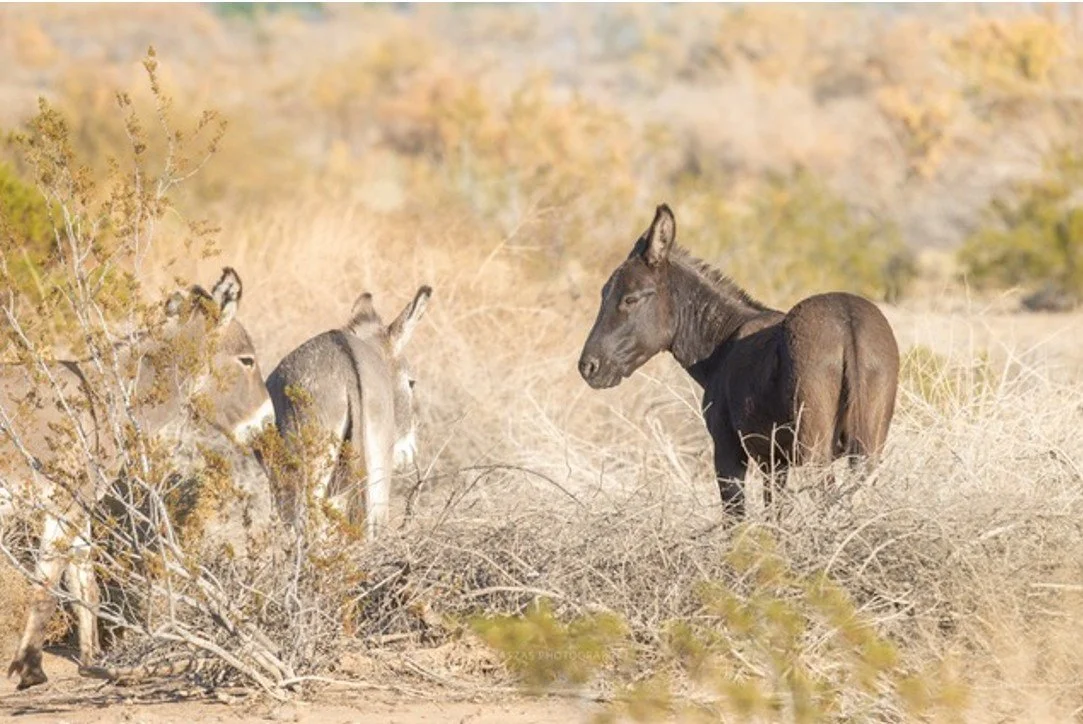
In 2020, the BLM Wild Horse Advisory Board recommended that studies be done on the physiological differences between horses and burros, which could affect their management processes. Donkey research is rare in the field of equine research. At long last, in 2025, Dr. Amy McClean, a UCDavis professor who directs the Wild Donkey Breeds Project, presented an hour-long overview for the Board on wild burro behavior and donkey-specific health issues. McClean grew up with mules and donkeys and feels strongly about their welfare. She later shared her personal view that “burros are as much a part of the ecosystem as big horn sheep or any native animal. Humans are the invasive feral species, not the donkeys.”
Founded in 1999, the Longhopes Donkey Shelter in Bennett, Colorado, was the first US donkey rescue to be accredited by the Global Federation of Animal Sanctuaries. Focusing on the long-term care of senior donkeys, Longhopes founder Kathy Dean has initiated several studies aimed at improving their welfare. One is titer research to assess the duration of antibody protection provided by equine vaccines. Another looks at the correlations between age, gender, weight, and Cushing’s disease syndrome. A third, in cooperation with the Colorado School of Mines, is developing maintenance tool prototypes for keeping paddocks manure-free.
Restoring Landscapes
Dr. Lundgren’s groundbreaking study on burro well-digging in Death Valley has stimulated new research on ways that wild burros and other introduced species may fill ecological holes left by large herbivores of the late Pleistocene era and “rewire ancient food webs.” In a recent interview with Heat Death magazine, Lungren noted that contrary to NPS doctrine, “we know of no species that is threatened or endangered by wild burros.” In fact, the removal of burros from the Ash Meadows National Wildlife Refuge led to the extinction of several endangered fish populations in the 1990’s.
More recently, owners of a vast outback station in northwest Australia found their large herd of wild donkeys transformed a barren tract that was rapidly desertifying into a lush oasis by breaking up rock-hard soil, dispersing seeds, cutting new paths for water flow, and restoring plant diversity. Despite the evidence, they’ve faced steep fines and threats to destroy their herd. (Carrying out government purges, Australian helicopter cowboys have killed over 570,000 feral donkeys since the 1980s.)
In Spain, volunteer organizations are fielding wild donkeys to graze down flammable vegetation in several provinces that have seen disastrous wildfires, including Andalusia, Catalonia, and Galicia. The government’s emergency military units have recognized the “donkey fire brigades” for creating low-fuel belts around villages and preventing new fire outbreaks. In Ourense province, donkeys are maintaining 2,470 acres in a UNESCO biosphere reserve.
Why It Matters
Donkey protection is a global cause. China’s demand for donkey hide gel (ejiao) results in 5 million being slaughtered each year. It feeds a black market that preys on villagers in remote rural areas of Africa and Asia who depend on donkeys for their livelihood. US-based Amazon is the world’s largest merchandiser of ejiao. Despite a massive petition campaign by BrookeUSA Foundation and allies, CEO Jeff Bezos refused to take it from their product list. In contrast, the African Union banned the trade in 2025.
The SAFE Act (HR 1661), which would end the export of wild and abandoned donkeys and horses for slaughter, now has 226 co-sponsors in the House. The Ejiao bill (HR 5544) would fine those involved in selling donkey hide products. BrookeUSA recently requested a Congressional investigation into China’s role in US-based ejiao commerce. Moving this agenda forward is possible despite enormous crosswinds for positive legislation.
Just boycott Amazon. Support WHE’s fight for land management reform, enforceable welfare standards, and change on the range. Lobby for the SAFE and Ejiao Acts along with the Wild Horse Protection Act (HR 4356) to prohibit helicopter roundups of wild horses and burros. Back rescues with proven records and staying power. And elect Congressional representatives open to reforming the government’s broken system.
In 2013, the National Academy of Sciences cautioned that removing burros permanently from the range “could jeopardize the genetic health of the total population.” Keeping wild burros on wild lands benefits the desert ecology. It enriches our lives. Free-roaming equids, says the 1971 Act, “contribute to the diversity of life forms within the nation.” Wild burros can stay nameless. But they need a fair shake, not the government’s path to extinction.
Originally published in the Spring 2026 issue of the Equine Collaborative International’s magazine, Groundwork
A retired foreign service officer, author Charlotte Roe is a democracy, wild equid, and public lands advocate and volunteer science advisor to The Cloud Foundation. She counts two burros, two mustangs, and an elder Andalusian as part of her Colorado family.